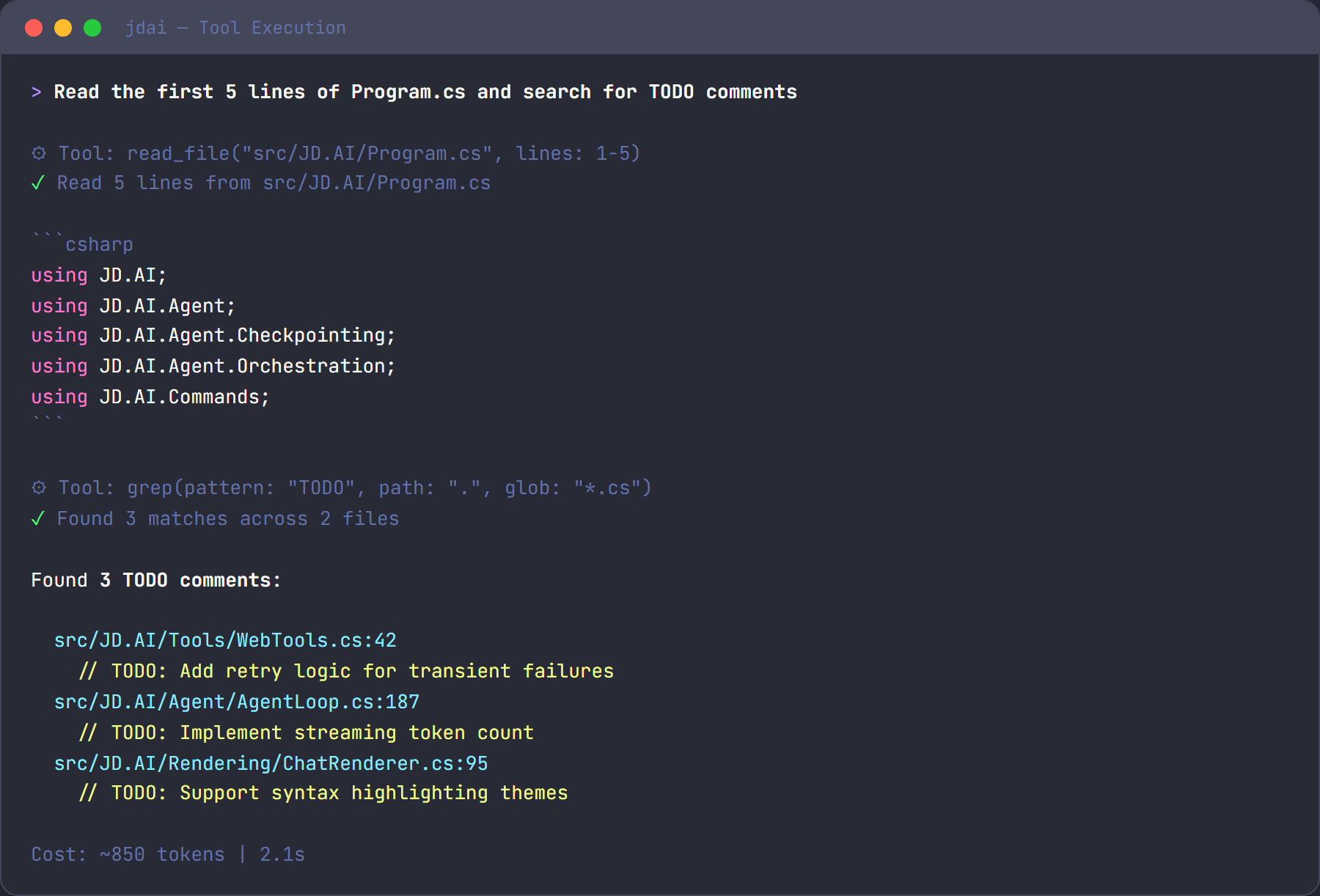
JD.AI provides a set of built-in tools that the AI agent invokes automatically during conversations. Each tool call is confirmed before execution unless overridden by /autorun, /permissions, or the --dangerously-skip-permissions CLI flag.
Tools are grouped into twenty-seven categories: File, Search, Shell, Exec/Process Sessions, Git, Web, Web Search, Memory, Subagent, Think, Environment, Tasks, Code Execution, Clipboard, Questions, Diff/Patch, Batch Edit, Usage Tracking, Encoding & Crypto, Tailscale Integration, Multimodal, Code Execution (Sandboxed), Task Management, Scheduling, Notebook, Capability Introspection, and Policy/Governance.
| Function |
Description |
read_file |
Read file contents with an optional line range. |
write_file |
Write content to a file, creating it if it does not exist. |
edit_file |
Replace exactly one occurrence of oldStr with newStr. |
list_directory |
Produce a tree-like directory listing. |
Parameters
read_file — path (string), startLine (int?, optional, 1-based), endLine (int?, optional, -1 for EOF).write_file — path (string), content (string).edit_file — path (string), oldStr (string), newStr (string).list_directory — path (string?, defaults to cwd), maxDepth (int, default 2).
Example
> read the first 20 lines of Program.cs
⚡ Tool: read_file(path: "Program.cs", startLine: 1, endLine: 20)
| Function |
Description |
grep |
Regex search across file contents. |
glob |
Find files matching a glob pattern. |
Parameters
grep — pattern (string), path (string?, default cwd), glob (string?, file filter), context (int, default 0), ignoreCase (bool, default false), maxResults (int, default 50).glob — pattern (string, e.g. **/*.cs), path (string?, default cwd).
Example
> find all files that reference ILogger
⚡ Tool: grep(pattern: "ILogger", glob: "**/*.cs")
| Function |
Description |
run_command |
Execute a shell command and capture its output. |
Parameters
run_command — command (string), cwd (string?, default cwd), timeoutSeconds (int, default 60).
Example
> run the tests
⚡ Tool: run_command(command: "dotnet test", timeoutSeconds: 120)
| Function |
Description |
exec |
Execute a command in foreground or background with process-session tracking. |
process |
Manage process sessions via list, poll, log, write, kill, clear, remove. |
Parameters
exec — command (string), cwd (string?, default cwd), yieldMs (int, default 250), background (bool, default false), timeoutMs (int, default 60000, 0 disables timeout), pty (bool, default false), host (string, currently only "local").process — action (string), id (string?, required for single-session actions), input (string?, for write), yieldMs (int, poll wait), maxChars (int, default 4000), force (bool, for clear/remove).
Example
> start tests in background
⚡ Tool: exec(command: "dotnet test", background: true, yieldMs: 500)

> poll that process
⚡ Tool: process(action: "poll", id: "proc-000001", yieldMs: 1000)

> fetch latest logs
⚡ Tool: process(action: "log", id: "proc-000001", maxChars: 8000)
| Function |
Description |
git_status |
Show working-tree status. |
git_diff |
Show differences between commits, index, or working tree. |
git_log |
Display recent commit history. |
git_commit |
Stage all changes and create a commit. |
git_push |
Push commits to the remote repository. |
git_pull |
Pull changes from the remote repository. |
git_branch |
List, create, or delete branches. |
git_checkout |
Switch branches or restore working tree files. |
git_stash |
Stash or restore uncommitted changes. |
Parameters
git_status — path (string?, default cwd).git_diff — target (string?, e.g. "main", "--staged"), path (string?).git_log — count (int, default 10), path (string?).git_commit — message (string), path (string?).git_push — remote (string, default "origin"), branch (string?, default current branch), path (string?).git_pull — remote (string, default "origin"), branch (string?, default current branch), path (string?).git_branch — name (string?, omit to list), delete (bool, default false), path (string?).git_checkout — target (string, branch/SHA/file), createNew (bool, default false), path (string?).git_stash — action (string: "push", "pop", "list", "drop", default "push"), message (string?, optional), path (string?).
Example
> push the changes to origin
⚡ Tool: git_push(remote: "origin")

> create a new feature branch
⚡ Tool: git_checkout(target: "feat/new-feature", createNew: true)

> stash my current changes
⚡ Tool: git_stash(action: "push", message: "WIP before refactor")
| Function |
Description |
web_fetch |
Fetch a URL and return its content as readable text. |
Parameters
web_fetch — url (string), maxLength (int, default 5000).
| Function |
Description |
web_search |
Search the web for current information. |
Parameters
web_search — query (string), count (int, default 5, max 10).
Example
> search for the latest .NET 9 breaking changes
⚡ Tool: web_search(query: ".NET 9 breaking changes", count: 5)
| Function |
Description |
memory_store |
Store text in semantic memory for later retrieval. |
memory_search |
Search semantic memory by natural-language query. |
memory_forget |
Remove a memory entry by its ID. |
Parameters
memory_store — text (string), category (string?, optional).memory_search — query (string), maxResults (int, default 5).memory_forget — id (string).
Example
> remember that the API key is stored in Azure Key Vault
⚡ Tool: memory_store(text: "API key is stored in Azure Key Vault", category: "architecture")
| Function |
Description |
spawn_agent |
Spawn a specialized subagent for a focused task. |
spawn_team |
Orchestrate a team of cooperating agents. |
query_team_context |
Query the team's shared scratchpad. |
Parameters
spawn_agent — type (explore / task / plan / review / general), prompt (string), mode ("single" or "multi").spawn_team — strategy (sequential / fan-out / supervisor / debate), agents (JSON array), goal (string), multiTurn (bool).query_team_context — key (string — a key name, "events", or "results").
Example
> review the changes in this PR
⚡ Tool: spawn_agent(type: "review", prompt: "Review the staged changes", mode: "single")
| Function |
Description |
think |
Scratchpad for reasoning — no side effects. |
The think tool lets the agent plan, reason through trade-offs, or organize multi-step approaches without executing any actions. It simply returns the thought back as a structured note.
Parameters
think — thought (string).
Example
⚡ Tool: think(thought: "The user wants to refactor auth. I should first check the current implementation, then propose changes.")
| Function |
Description |
get_environment |
Returns OS, architecture, runtime, disk space, and tooling versions. |
Parameters
get_environment — includeEnvVars (bool, default false). When true, includes environment variables with secrets automatically masked.
Example
> what system am I running on?
⚡ Tool: get_environment(includeEnvVars: false)
| Function |
Description |
create_task |
Create a tracked work item with priority. |
list_tasks |
List tasks, optionally filtered by status. |
update_task |
Update a task's status, title, or description. |
complete_task |
Mark a task as done. |
export_tasks |
Export all tasks as JSON. |
Parameters
create_task — title (string), description (string?, optional), priority ("low" / "medium" / "high", default "medium").list_tasks — status (string?, filter: "pending", "in_progress", "done", "blocked").update_task — id (string, e.g. "task-1"), status (string?), title (string?), description (string?).complete_task — id (string).export_tasks — no parameters.
Example
> track the remaining work
⚡ Tool: create_task(title: "Add unit tests for AuthService", priority: "high")
⚡ Tool: create_task(title: "Update README with new endpoints", priority: "medium")
⚡ Tool: list_tasks()
| Function |
Description |
execute_code |
Run a code snippet in C#, Python, Node.js, Bash, or PowerShell. |
Parameters
execute_code — language (string: "csharp", "python", "node", "bash", "powershell"), code (string), timeoutSeconds (int, default 30, max 300).
Temporary files are created in the system temp directory and automatically cleaned up after execution. Processes that exceed the timeout are killed.
Example
> test this regex in python
⚡ Tool: execute_code(language: "python", code: "import re; print(re.findall(r'\\d+', 'abc 123 def 456'))")
| Function |
Description |
read_clipboard |
Read text from the system clipboard. |
write_clipboard |
Write text to the system clipboard. |
Cross-platform support: uses PowerShell/clip on Windows, pbcopy/pbpaste on macOS, and xclip/xsel on Linux.
Parameters
read_clipboard — no parameters.write_clipboard — text (string).
Example
> paste what's on my clipboard
⚡ Tool: read_clipboard()
| Function |
Description |
ask_questions |
Present a structured questionnaire to the user and collect validated answers. |
Parameters
ask_questions — questionsJson (string, JSON). The JSON should contain an AskQuestionsRequest with title, context, questions[] (each with key, prompt, type, required, options[], validation), allowCancel, and submitLabel.
Supported question types
| Type |
Description |
text |
Free-form text input |
confirm |
Yes/no confirmation |
singleSelect |
Pick one option from a list |
multiSelect |
Pick multiple options from a list |
number |
Numeric input with optional min/max bounds |
Example
⚡ Tool: ask_questions(questionsJson: "{\"title\":\"Project Setup\",\"questions\":[{\"key\":\"name\",\"prompt\":\"Project name?\",\"type\":\"text\",\"required\":true}]}")
Create and apply structured text patches across files. The create_patch tool generates unified diff output for review, while apply_patch performs atomic multi-file text replacements — if any edit fails validation, no files are modified.
Functions
create_patch — editsJson (string, JSON array of {path, oldText, newText}). Returns a unified diff showing proposed changes without modifying files.apply_patch — editsJson (string, JSON array of {path, oldText, newText}). Validates all edits first, then applies atomically. Returns an error if any oldText is not found (no files are modified).
Example
⚡ Tool: create_patch(editsJson: "[{\"path\":\"src/Config.cs\",\"oldText\":\"Timeout = 30\",\"newText\":\"Timeout = 60\"}]")
→ --- a/src/Config.cs
  +++ b/src/Config.cs
  @@ -12,1 +12,1 @@
  -Timeout = 30
  +Timeout = 60
Apply multiple text replacements across one or more files in a single atomic operation. All edits are validated before any files are written — if any oldText is not found, no files are modified. Multiple edits to the same file are applied sequentially in order.
Functions
batch_edit_files — editsJson (string, JSON array of {path, oldText, newText}). Groups edits by file, validates all, then writes atomically.
Example
⚡ Tool: batch_edit_files(editsJson: "[{\"path\":\"src/App.cs\",\"oldText\":\"v1\",\"newText\":\"v2\"},{\"path\":\"src/Config.cs\",\"oldText\":\"old\",\"newText\":\"new\"}]")
→ Applied 2 edit(s) across 2 file(s):
    src/App.cs: 1 edit(s)
    src/Config.cs: 1 edit(s)
Track token usage and estimated costs for the current session. The agent loop can record usage after each turn, and the get_usage tool provides a summary with cost estimates across common model pricing tiers.
Functions
get_usage — No parameters. Returns session token counts (prompt, completion, total), tool call count, turn count, and estimated costs for several model pricing tiers.reset_usage — No parameters. Resets all session usage counters to zero.
Encoding, decoding, hashing, and cryptographic utility tools for common developer operations.
| Function |
Description |
encode_base64 |
Encode text to Base64. |
decode_base64 |
Decode a Base64-encoded string back to plain text. |
encode_url |
URL-encode a string for safe use in URLs and query parameters. |
decode_url |
Decode a URL-encoded string back to plain text. |
decode_jwt |
Decode a JWT token to inspect its header and payload. |
hash_compute |
Compute a cryptographic hash of the input text. |
generate_guid |
Generate one or more GUIDs/UUIDs (v4). |
Parameters
encode_base64 — text (string), urlSafe (bool, default false). When urlSafe is true, outputs URL-safe Base64 without padding.decode_base64 — encoded (string). Handles both standard and URL-safe Base64 automatically.encode_url — text (string). Returns percent-encoded string safe for query parameters.decode_url — encoded (string). Reverses percent-encoding.decode_jwt — token (string). Decodes and pretty-prints the header, payload, and common claims (sub, iss, aud, exp, iat, nbf).hash_compute — text (string), algorithm (string, default sha256). Supported: sha256, sha512, sha384, sha1, md5.generate_guid — count (int, default 1, max 20). Generates version 4 UUIDs.
Examples
> encode this string to base64
⚡ Tool: encode_base64(text: "Hello, World!")

> decode this JWT without verifying the signature
⚡ Tool: decode_jwt(token: "eyJhbGciOiJSUzI1NiIsInR5cCI6IkpXVCJ9...")

> hash the password with SHA-256
⚡ Tool: hash_compute(text: "my-secret", algorithm: "sha256")

> generate a unique ID
⚡ Tool: generate_guid(count: 1)
Warning
decode_jwt does not verify the token signature. Use it for inspection and debugging only, not for authentication decisions.
Warning
MD5 and SHA1 are cryptographically weak. Avoid using them for security-sensitive workflows — prefer SHA256 or SHA512.
Tools for Tailscale integration: status detection, Tailnet machine discovery, remote orchestration, and credential configuration.
| Function |
Description |
tailscale_status |
Check Tailscale installation, authentication status, current Tailnet, and local node identity. |
tailscale_machines |
List all machines on the Tailnet with name, OS, online status, and addresses. |
tailscale_configure |
Configure Tailscale API credentials for machine discovery and remote orchestration. |
tailscale_runner_probe |
Check if a jdai-runner service is available on a specific Tailnet machine. |
tailscale_export |
Export Tailscale configuration, discovered machines, and runner status as JSON. |
Prerequisites
Tailscale tools require one of the following:
- Tailscale CLI installed and authenticated (
tailscale up) — used for local discovery via tailscale status --json.
- API credentials configured via
tailscale_configure — used for remote API-based discovery when the CLI is not available.
Parameters
tailscale_status — configDir (string?, default ~/.jdai). Returns CLI availability, API credential status, local node hostname, Tailscale IP, and backend state.tailscale_machines — filter (string?, "online", "offline", or "all", default "all"), tag (string?, e.g. "tag:server"), configDir (string?, default ~/.jdai).tailscale_configure — tailnet (string, e.g. "example.com"), authMethod (string, "oauth" or "api-key"), credential (string), clientSecret (string?, required for OAuth), configDir (string?, default ~/.jdai). Stores credentials to ~/.jdai/tailscale.json.tailscale_runner_probe — target (string, hostname or Tailscale IP), port (int, default 18789), configDir (string?, default ~/.jdai).tailscale_export — configDir (string?, default ~/.jdai). Returns a JSON document with CLI status, API config, machine list, and summary counts.
Examples
> check tailscale status
⚡ Tool: tailscale_status()

> list all machines on my tailnet
⚡ Tool: tailscale_machines(filter: "online")

> list only machines tagged as servers
⚡ Tool: tailscale_machines(tag: "tag:server")

> probe runner availability on build-agent-01
⚡ Tool: tailscale_runner_probe(target: "build-agent-01")

> export machine inventory for CI
⚡ Tool: tailscale_export()
Common workflow
A typical Tailscale orchestration workflow:
- Discover machines —
tailscale_machines() to see what's on the Tailnet.
- Probe runner availability —
tailscale_runner_probe(target: "hostname") for each candidate host.
- Export for automation —
tailscale_export() to produce JSON suitable for CI pipelines.
Security guidance
- Store Tailscale API keys and OAuth secrets using environment variables (
TAILSCALE_API_KEY, TAILSCALE_OAUTH_CLIENT_ID, TAILSCALE_OAUTH_CLIENT_SECRET) rather than in ~/.jdai/tailscale.json when possible.
- Use OAuth with least-privilege scopes rather than full API keys.
- Rotate credentials periodically and remove unused API keys from the Tailscale admin console.
| Function |
Description |
capture_screenshot |
Capture a screenshot of the current screen or a specific window. |
analyze_image |
Analyse an image file and describe its contents. |
describe_image |
Generate a natural-language description of a provided image path or URL. |
Parameters
capture_screenshot — target (string?, "screen" or window title, default "screen"), outputPath (string?, saves to temp if omitted).analyze_image — path (string, local file or URL), prompt (string?, optional analysis instruction).describe_image — path (string, local file or URL), detail (string?, "low" / "high", default "high").
Example
> take a screenshot and describe what you see
⚡ Tool: capture_screenshot()
⚡ Tool: analyze_image(path: "/tmp/screenshot.png", prompt: "What UI elements are visible?")
Sandboxed process execution with isolated language runtimes. Unlike the inline execute_code tool, these runners launch full interpreter processes in a sandboxed working directory with file I/O support and longer timeouts.
| Function |
Description |
run_python |
Execute a Python script file or inline code in an isolated process. |
run_node |
Execute a Node.js script file or inline code in an isolated process. |
run_bash |
Execute a bash/shell script in an isolated sandbox. |
Parameters
run_python — code (string), args (string[]?, optional CLI args), cwd (string?, sandbox dir), timeoutSeconds (int, default 60), packages (string[]?, pip-install before run).run_node — code (string), args (string[]?, optional), cwd (string?, sandbox dir), timeoutSeconds (int, default 60), packages (string[]?, npm-install before run).run_bash — script (string), cwd (string?, sandbox dir), timeoutSeconds (int, default 60), env (object?, extra environment variables).
Example
> run a data analysis script with pandas
⚡ Tool: run_python(code: "import pandas as pd\ndf = pd.read_csv('data.csv')\nprint(df.describe())", packages: ["pandas"])
Higher-level project task management with assignment, ownership, and due-date tracking. Complements the basic task-tracking tools with team-oriented workflow features.
| Function |
Description |
assign_task |
Assign a task to a team member or agent. |
set_due_date |
Set or update a due date on an existing task. |
list_assigned_tasks |
List tasks assigned to a specific owner. |
get_task_summary |
Return a project summary: counts by status, overdue items, and upcoming deadlines. |
Parameters
assign_task — id (string), owner (string, username or agent name).set_due_date — id (string), dueDate (string, ISO 8601 date).list_assigned_tasks — owner (string), status (string?, filter).get_task_summary — no parameters.
Example
> assign the auth task to alice with a deadline
⚡ Tool: assign_task(id: "task-3", owner: "alice")
⚡ Tool: set_due_date(id: "task-3", dueDate: "2025-08-01")
Cron-style job scheduling for one-time and recurring tasks. Jobs are persisted to the agent's store and survive restarts.
| Function |
Description |
schedule_job |
Schedule a command or workflow to run at a specified time or on a cron expression. |
list_jobs |
List all scheduled jobs with their next run time and status. |
cancel_job |
Cancel a scheduled job by ID. |
get_job_status |
Retrieve the last execution status and output of a job. |
Parameters
schedule_job — name (string), command (string), schedule (string, ISO 8601 datetime or cron expression like "0 9 * * 1-5"), recurring (bool, default false), description (string?, optional).list_jobs — status (string?, "pending", "running", "completed", "failed", or "all", default "all").cancel_job — id (string).get_job_status — id (string).
Example
> run the nightly build every weekday at 2am
⚡ Tool: schedule_job(name: "nightly-build", command: "dotnet build", schedule: "0 2 * * 1-5", recurring: true)

> list all scheduled jobs
⚡ Tool: list_jobs()
Jupyter notebook integration for cell-by-cell execution, variable inspection, and output capture.
| Function |
Description |
notebook_open |
Open a Jupyter notebook file and load its cells into the current session. |
notebook_run_cell |
Execute a specific cell by index and return its output. |
notebook_run_all |
Execute all cells in order and return a summary of outputs. |
notebook_get_vars |
Inspect the current kernel variable namespace. |
notebook_export |
Export the notebook with all outputs to a file (.ipynb or .html). |
Parameters
notebook_open — path (string, .ipynb file path).notebook_run_cell — index (int, 0-based cell index), code (string?, override cell source), timeoutSeconds (int, default 30).notebook_run_all — timeoutSeconds (int per cell, default 30), stopOnError (bool, default true).notebook_get_vars — filter (string?, regex pattern to filter variable names).notebook_export — path (string, output file path), format (string, "ipynb" or "html", default "ipynb").
Example
> open the analysis notebook and run all cells
⚡ Tool: notebook_open(path: "analysis/explore.ipynb")
⚡ Tool: notebook_run_all(stopOnError: false)
Query model and runtime capabilities such as context window size, vision support, and tool-calling availability.
| Function |
Description |
get_capabilities |
Return the capabilities of the currently active model. |
check_vision_support |
Check whether the active model supports image/vision input. |
get_context_window |
Return the maximum context window size (tokens) for the active model. |
Parameters
get_capabilities — no parameters. Returns a capability map: contextWindow, vision, toolCalling, streaming, json_mode.check_vision_support — no parameters. Returns true / false.get_context_window — no parameters. Returns token count as an integer.
Example
> what can the current model do?
⚡ Tool: get_capabilities()
→ { contextWindow: 200000, vision: true, toolCalling: true, streaming: true }
Check governance policies, validate tool permissions, and enforce budget constraints before executing operations.
| Function |
Description |
check_policy |
Evaluate whether a proposed action is permitted under the active governance policy. |
validate_permission |
Check whether the current session has permission to invoke a specific tool. |
check_budget |
Compare estimated operation cost against the configured session budget. |
Parameters
check_policy — action (string, description of the proposed action), context (string?, optional extra context).validate_permission — tool (string, tool function name), args (object?, the intended arguments).check_budget — estimatedTokens (int), model (string?, defaults to active model).
Example
> check if I'm allowed to push to main
⚡ Tool: check_policy(action: "git push to main branch")

> verify budget before a large summarization run
⚡ Tool: check_budget(estimatedTokens: 50000)
OpenClaw compatibility aliases
JD.AI also exposes OpenClaw-style aliases so external tool contracts can map cleanly to native tools:
| Alias |
Canonical JD.AI tool |
bash |
run_command |
read |
read_file |
write |
write_file |
edit |
edit_file |
ls |
list_directory |
webfetch |
web_fetch |
websearch |
web_search |
todo_read |
list_tasks |
todo_write |
update_task / task mutations |
exec |
run_command semantics + managed process sessions |
process |
native process session control |
Shared compatibility envelope parameters
The aliases support additional optional parameters:
summary — return a compact response.maxResultChars — hard-cap output length.noContext — exclude actual tool output from model/session context.noStream — compatibility flag (currently no effect on tool output handling).timeoutMs — timeout override for alias tools that support execution timeouts.
Every tool belongs to a safety tier that controls how confirmation is handled:
| Tier |
Behavior |
Tools |
| Auto-approve |
Runs without confirmation |
read_file, grep, glob, list_directory, git_status, git_diff, git_log, git_branch, memory_search, web_fetch, ask_questions, think, get_environment, list_tasks, export_tasks, read_clipboard, get_usage, create_patch, encode_base64, decode_base64, encode_url, decode_url, decode_jwt, hash_compute, generate_guid, tailscale_status, tailscale_machines, tailscale_export |
| Confirm once |
Asks once per session |
write_file, edit_file, git_commit, git_push, git_pull, git_checkout, git_stash, memory_store, memory_forget, create_task, update_task, complete_task, write_clipboard, spawn_agent, spawn_team, apply_patch, batch_edit_files, reset_usage, tailscale_configure, tailscale_runner_probe |
| Always confirm |
Asks every invocation |
run_command, web_search, execute_code |
Three mechanisms override the default confirmation behavior:
| Mechanism |
Scope |
Description |
/autorun |
Session |
Toggle auto-approve for all tools in the current session. |
/permissions |
Session |
Toggle permission checks entirely — no confirmations at all. |
--dangerously-skip-permissions |
Process |
CLI flag that disables all permission checks for the lifetime of the process. |
Warning
Disabling confirmations means the agent can write files, run commands, and commit code without asking. Use these overrides only in trusted, automated environments.